
LazAI Explainer Challenge
Claim Layer3 rewards

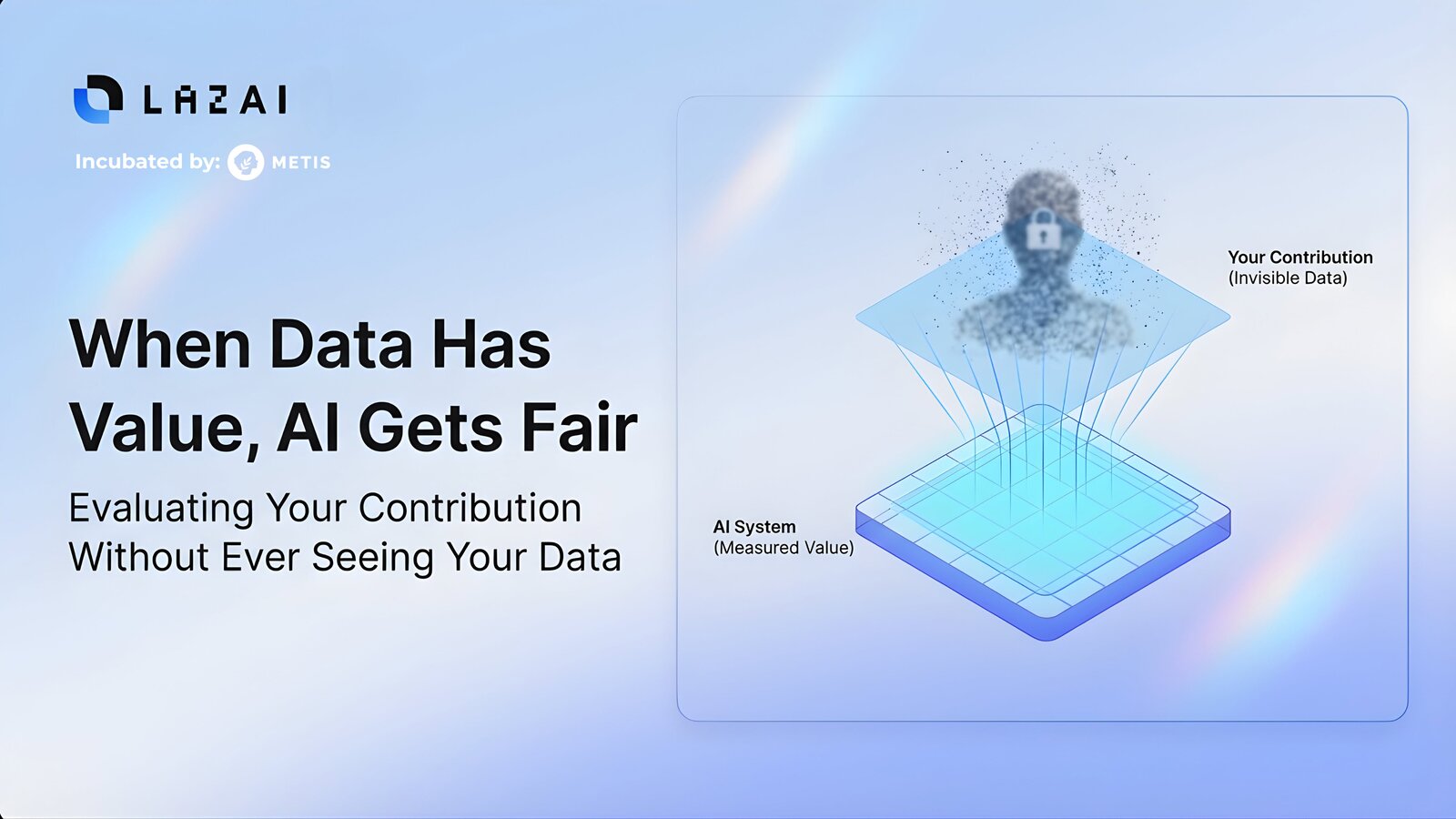

LazAI team and UBC Blockchain Research Center publish joint paper, accepted at IEEE ICME 2026 (28.89% acceptance rate)
As Web3 and AI increasingly blend into decentralized digital ecosystems, a practical question is becoming harder to avoid: who should AI services prioritize?
Many systems still follow a pay-first rule. The more you pay, the more AI resources you receive. Meanwhile, the people who contribute data and genuinely help AI improve may not receive benefits that match their contribution. At the same time, data value and privacy risk often rise together. The more useful the data is, the more users worry that contributing it could reveal personal details, daily habits, or other sensitive information.
This creates two major bottlenecks that slow down sustainable AI adoption:
Our work, accepted at the IEEE International Conference on Multimedia and Expo (ICME 2026), aims to provide a more user-friendly answer. Users should not need to upload raw data to prove contribution. Instead, the system should be able to assess the value of a user's data contribution while keeping privacy protected, then convert that value into fairer and more stable AI usage quotas.
In short: data contribution becomes a passport to AI usage rights — without forcing users to trade away privacy.
To make AI service both fast and fair, the system adopts a cloud, edge, and user collaboration model that stays close to how modern AI services are actually delivered.
The technical core is a closed loop that links three elements together: data contribution, a value signal, and usage quota allocation. Two mechanisms make this loop practical and explainable to general users.
(A) Data Contribution Receipts: Recording Value Without Exposing Raw Data
The system records contributions through a digital credential called a Data Anchoring Token (DAT), acting as a contribution receipt. When a user contributes data, the system produces a verifiable contribution record that can later be used to adjust the user's quota. Importantly, this credential is designed to reflect contribution value rather than exposing the user's raw data.
(B) Topic-Based Data Directories: Comparing Apples to Apples
The system organizes contributions into semantic-based data clusters through Individualistic Decentralized Organization (iDAO) groups — topic-driven catalogs that ensure contextual accuracy. By moving away from a "one-size-fits-all" pool, the system evaluates performance through like-for-like analysis within relevant sectors: pet data against pet data, traffic against traffic. This structured approach provides clearer insights and ensures that data valuations are fair and meaningful within their specific context.
Resource allocation is implemented through an intuitive quota model. AI quotas work like redeemable service coupons.
The key difference from traditional subscription tiers is the rule that allocates quotas. In common pay-first systems, quotas are set by payment level. In this research, quota allocation is driven by privacy-preserving data valuation. Users who contribute higher-quality, more unique, and more timely data receive a larger quota and can access more AI services. Users who contribute less still receive a baseline level of access, supporting a core principle of universal usability.
In effect, fairness becomes an executable rule in the system. It avoids both monopoly and waste, and it ensures contributors receive real, measurable benefits.
A central challenge is measuring data value while protecting privacy. The valuation logic considers multiple dimensions — it's not just about how much data a user provides, but also how useful and timely it is.
Most importantly, the system is built so that users do not need to upload raw data. Instead, user data is transformed into a high-dimensional numeric representation that captures general semantic characteristics. The system then applies privacy protection so that the edge server can evaluate value from the processed representation while making it significantly harder to infer the original content or personal identifiers.
The intended outcome is a strong separation between value and exposure: the system can compute how valuable a contribution is, but it should not learn the sensitive details a user wants to keep private.
Privacy claims must be backed by evidence, not marketing language. To test privacy robustness, the research uses a standard evaluation approach in the literature: reconstruction attacks. In this setting, an attacker attempts to "stitch back" the user's original data from the signals visible to the system.
Experimental comparisons indicate a clear gap:
A straightforward interpretation: the system still understands the type of contribution and can measure its value, but it becomes much harder to infer what the exact content was or who the user is.
That is the privacy goal in a contribution economy: value remains usable, while personally identifiable content remains protected.
Within Crypto and Web3, related products and research directions often follow several recognizable routes:
Our positioning is best understood as closing a loop that many systems leave open. We combine privacy protection and quota allocation into a single mechanism: the system produces a privacy-preserving value signal for data contributions, then directly uses that value signal to adjust each user's AI usage quota.
The difference in one sentence: Many approaches address how to trade data or compute, or how to run private computation. This work concentrates on how to convert data contribution into explainable, enforceable AI usage rights — with privacy protection designed as the starting point rather than an afterthought.
This research aligns with the rise of personalized AI services and AI agents. In the near future, a single user may operate multiple assistants: an email helper, a study coach, a travel planner, and a creative partner. These agents will require stable and predictable access to AI resources. Users may also be willing to contribute data that improves the system's overall intelligence, but they do not want privacy to become the cost of participation.
The proposed mechanism offers a practical path forward. It converts privacy-preserving data valuation into fair AI usage quotas while supporting a stable service experience — reducing wait times and preventing data contributors from being undervalued.
From an ecosystem perspective:
"In the AI era, everyone's data contribution has unique value. We hope resource allocation will move beyond the idea of 'who pays gets priority' toward 'who contributes benefits.' Moreover, users should not have to sacrifice privacy to receive fair recognition. Our goal is to let the system identify contribution value without seeing raw data, then convert that value into real, usable AI quotas. This is how decentralized AI can become both more equitable and more trustworthy."— Ming Guo, Co-founder of LazAI
This project is carried out through a Mitacs-supported academic partnership and talent development program, with ecosystem engagement that includes industry partners. The research was developed by a team affiliated with The University of British Columbia (UBC) in Vancouver, Canada, and is connected to Blockchain@UBC, a multidisciplinary research cluster that explores blockchain technologies and how emerging technologies can benefit Canada and the broader global community — linking academic insight with industry needs, including structured cross-disciplinary training through its Blockchain Graduate Training Pathway.
Industry ecosystem partners include:
Metis is building full-stack Web3 infrastructure designed for AI agents. Its settlement layer, Andromeda, is the first Layer 2 to implement a decentralized sequencer. Its scaling layer, Hyperion, provides a high-performance execution environment for AI workloads. And its application layer, LazAI, uses the DAT asset standard to transform AI data and agent behavior into verifiable, ownable, and revenue-generating on-chain assets. Three layers working in concert to power the decentralized agent economy.
LazAI Network is a Web3-native decentralized AI ecosystem for building agents and data-driven AI assets, with a mission to align AI with humanity. Through iDAO and the DAT standard, LazAI addresses three core challenges in AI: the difficulty of sharing data, evaluating data quality, and distributing revenue fairly. Its Alpha Mainnet is live.
The IEEE International Conference on Multimedia and Expo (ICME) is a flagship multimedia conference jointly sponsored by four IEEE societies: Computer, Circuits and Systems, Signal Processing, and Communications. Since its founding in 2000, ICME has served as a leading forum for advances in multimedia technologies, systems, and applications, attracting researchers, developers, and practitioners from academia and industry.
ICME 2026 will be held in Bangkok, Thailand, under the theme "Beyond Perception: Intelligent Media in the Age of Autonomous Agents." This year's conference received 3,810 submissions and accepted 1,101 papers, for an acceptance rate of 28.89%.
If you are building AI services, operating Web3 platforms, designing incentive mechanisms, or researching privacy and fairness, we welcome discussion and collaboration around privacy-preserving data valuation and quota-based AI access. Paper, code, and demo links will be added when available.
Media Contact: [email protected]


