
LazAI Explainer Challenge
Claim Layer3 rewards



The launchpad landscape is experiencing its most significant transformation since DeFi summer 2021. AI-native launchpads represent the convergence of artificial intelligence and decentralized finance, creating ecosystems where value is shaped not just by investment, but by interaction, contribution, and community co-creation.
Traditional crypto launchpads like Binance Launchpad and Polkastarter revolutionized fundraising by enabling global access to token sales through transparent blockchain mechanisms. These platforms introduced allocation models based on token holdings, staking, or lottery systems, breaking down barriers that once limited venture capital to accredited investors.
But the next wave is fundamentally reimagining what it means to "launch" a project. The shift to ‘Launchpads 3.0’ emphasizes community-powered fundraising, AI-driven insights, and next-generation liquidity provisioning. Users can interact, contribute, and directly influence which projects succeed.
Investors want curation from people with skin in the game, not algorithmic allocation through staking tiers or lotteries. The group-led model addresses this by pairing expert deal flow with transparent alignment. Platforms like Echo exemplify this approach, where experienced investors curate deals and community members co-invest on identical terms. Leads can only share opportunities when they themselves have invested, creating natural alignment and enabling wider token distributions instead of concentrated VC holdings. However, Echo is mainly limited to accredited investors.

Data Anchoring Tokens (DATs) represent the shift from static allocation to participatory value creation. Unlike traditional tokens distributed through sales, DATs transform AI agents into memory-aware assets that evolve through community interaction before launch. AI-powered vetting uses natural language processing to analyze project credibility, machine learning to detect red flags in tokenomics, and sentiment analysis to gauge community trust. Users shape agent development through real decisions, creating decentralized curation where every click becomes data and every action proves market fit. This eliminates centralized gatekeepers deciding what launches, replacing them with transparent, engagement-driven selection.
AI launchpads require blockchain infrastructure capable of on-chain AI execution. Platforms are deploying AI-optimized Layer 2 solutions with parallel execution and low latency designed to support AI workloads alongside traditional DeFi applications. Without networks handling AI inference and real-time interactions, AI-native launchpads remain theoretical.
The convergence of scalable infrastructure with DAT tokenization and dynamic liquidity provisioning creates the foundation for sustainable AI asset ecosystems where value flows to contributors, not intermediaries.
LazPad synthesizes emerging trends through its Pad + Fun philosophy on the Metis ecosystem, merging Virtuals' structured approach with Pump.fun's accessibility while adding pre-assetization engagement.
The platform operates across three zones. Explore Zone is where users interact with unminted agents, complete missions, and shape personalities. Every interaction gets recorded via Data Anchoring Tokens, transforming engagement into verifiable data. Open Launch enables permissionless assetization with price unlock mechanisms preventing premature token release. Premium Launch offers curated launches for vetted projects.
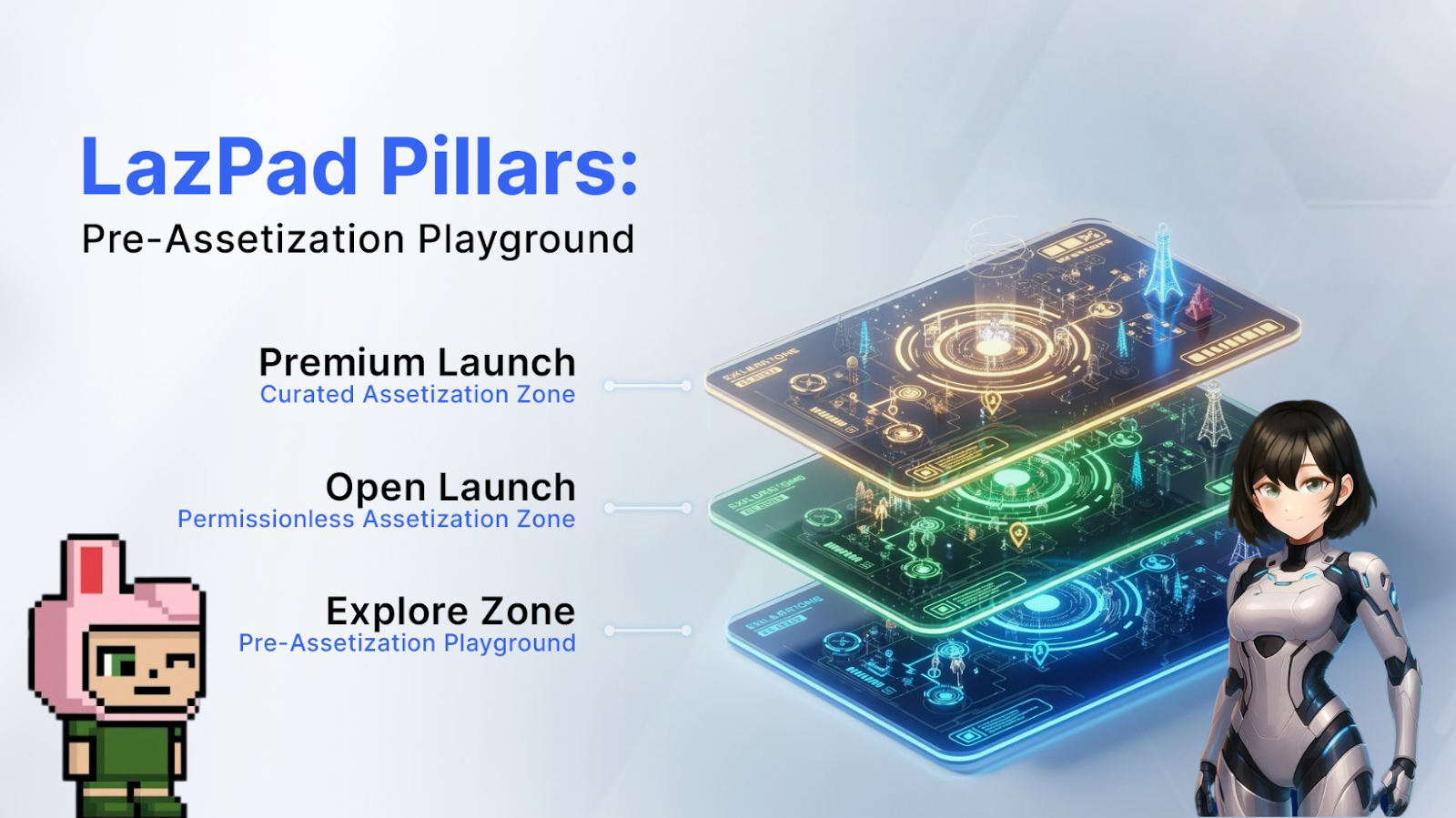
This structure solves the core problem: agents prove value through real engagement before tokenization. Integration with LazAI creates an internal economy where users raise companions like Lazbubu and developers use the Alith framework, keeping value within the ecosystem.
Built on Metis and powered by Hyperion, LazPad builds emotional data economies where community interaction determines what becomes valuable. The idea of what a launchpad can be is changing fast. Visit LazPad.fun and join the LazPad community to experience the next generation of launchpads firsthand.


