LazAI Explainer Challenge
Claim Layer3 rewards


LazAI’s Perspective on AI Workflow Architecture
-- By the LazAI Team
Today, almost no one doubts the capabilities of large models anymore.
AI can write code, conduct research, summarize information, break down tasks, and generate content. Many scenarios that once belonged only to imagination have, over the past two years, been turned into reality through one demo after another. From a capability standpoint alone, the upper bound of AI is already astonishing.
And yet, that is exactly where the strange part begins.
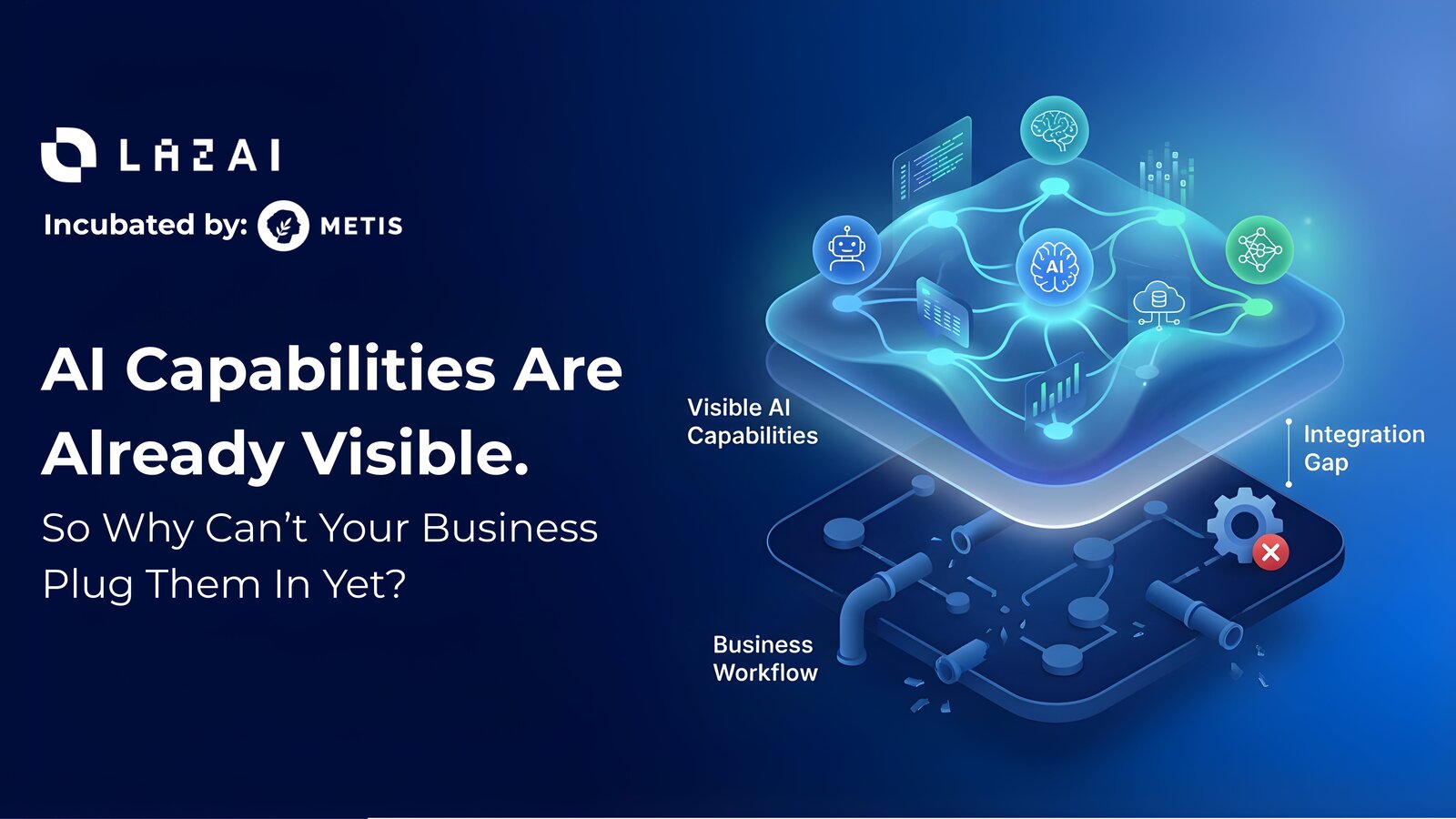
Why is it that everyone can see what AI is capable of, but the moment we try to connect it to real business workflows, things still fall apart?
Why do so many systems look smooth in demos, only to start breaking down once they enter real operational environments?
Why is it that domain experts, who understand their business boundaries better than anyone, still struggle to hand those judgments over to AI in a stable, reliable way?
At the end of the day, the real pain point is no longer whether AI can be used at all.
It is this: AI capabilities are already visible, but their operationalization remains extremely scarce.
At LazAI, we increasingly believe that the issue is often not that the model is not smart enough. The issue is that we still lack an engineering method for truly translating expertise into AI systems. Domain experts obviously know their own business constraints, judgment criteria, and critical workflows. But for years, much of that knowledge has remained implicit, buried in experience, team intuition, and repeated human decisions. If AI is going to be integrated in a meaningful way, that knowledge first has to be extracted, structured, and turned into a system.
That is why we have become increasingly convinced of one thing: what is missing today is not another chat-based agent, nor another flashy AI tool.
What is really missing is a way to organize expertise into closed-loop workflows that are executable, verifiable, and reusable.
Over the past months, we have repeatedly observed the same pattern: when teams try to bring AI into production, they often end up falling into one of three common modes.
The first is prompt-only.
At first glance, this feels like the lightest and most flexible path. It is also the easiest to start with. Many people assume that as long as the prompt is written clearly enough, AI will naturally do the job correctly. But in reality, that is rarely enough. Prompts can solve part of the problem, but they cannot sustain long-term stability in complex business environments. Local constraints easily break down, rules drift as context grows longer, and version control becomes difficult. Put more directly, many teams do not lack prompts. What they lack is a system, because too much system responsibility has been pushed onto the prompt itself.
The second is workflow-only.
This path has obvious strengths too. It is stable, controllable, and easy to replicate. But the downside is just as real: once everything is hardcoded into rigid flows, the model’s real strength — its ability to generalize, adapt, and handle dynamic situations — gets flattened. The system may look stable on the surface, but underneath, it risks becoming nothing more than a more complicated orchestration engine, while the intelligence of the model is never truly allowed to operate.
The third is chat-only.
Conversation matters. In many cases, it is the most natural interface for expressing intent. Humans instinctively begin by stating what they want. But that is also where the limitation appears. Chat is excellent for capturing initial intent, but it is far less capable of independently carrying complex task state, execution orchestration, risk confirmation, and final validation. You can start a process through chat. But it is very hard to run a serious workflow through chat alone over time.
None of these approaches is entirely wrong.
The real problem is that each of them only addresses one part of the system.
And in complex business environments, the most dangerous thing is precisely solving only one part.
That is why, at LazAI, we increasingly agree with a judgment that may feel counterintuitive, but is critical:
Integrating AI is not magical efficiency by default. In fact, when you begin designing a real control structure, short-term development efficiency often goes down rather than up.
Because before AI can reliably participate, all the tacit knowledge that was previously carried by experience and team intuition has to be broken down into rules, state, constraints, checks, and feedback loops. It is a tedious process. It is not glamorous. It does not look like a demo. But it is necessary. Without it, the system may appear to function, when in reality it is simply hiding uncertainty beneath the surface.
The model may be the engine.
But what determines whether a system can actually enter the business environment is usually everything around it: the surrounding constraints, state, and verification mechanisms.
These judgments are not abstract speculation.
Whether in web development workflows, content systems, coordination pipelines, or complex task decomposition, we keep running into the same reality: in the AI era, engineering discipline has not disappeared. It has simply moved.
In the past, engineers primarily used code to define system logic directly.
Now, more and more of the work is shifting toward domain modeling, constraint design, state management, validation flows, and system debugging. Generation and execution can increasingly be absorbed by AI. But the structure and rules around that execution become even more important.
And through that process, we have learned some hard lessons.
These are not mere tricks. They are survival lines.
First, white-box visibility is a survival requirement.
If a system’s outputs cannot be read, modified, or verified, it cannot sustain itself in complex professional environments. A black-box demo may impress once. A white-box system is what earns the right to enter production.
Second, reject long monolithic prompts.
Rules need to be modular. They need to form local closed loops. Otherwise, as context expands, constraints begin to loosen, and the system starts to look like it is executing while actually drifting away from the intended path.
Third, generation and verification cannot be overly homologous.
If the same logic is responsible for both producing outputs and judging whether those outputs are correct, the system will naturally develop blind spots. The easiest thing for it to fool is often itself.
Fourth, do not blindly chase the strongest model.
Model selection is not an exercise in parameter worship. It is a system decision. Capability, stability, cost, speed, and task fit must all be evaluated together. The most powerful model is not always the most valuable one. The most valuable one is the model best suited to operate inside the system you are actually building.
All of these lessons point to the same conclusion:
The real challenge in AI today is no longer just making the model smarter.
It is making the system more reliable.
If AI were only a content generation tool, all of these issues might still look like product and engineering problems.
But it does not stop there.
As AI moves from generation to execution, from answering to coordination, from assistance to delivery, it inevitably enters a much larger structure. At that point, the basic unit of software may no longer remain the standalone app. Instead, it may gradually shift toward systems connected by agents. Knowledge, tasks, payments, coordination, state, and results will increasingly be woven into one continuous workflow.
At that stage, the problem is no longer just workflow.
How does an agent identify itself?
Why should it be trusted?
How does it collaborate with other agents?
How does it handle payment and settlement?
How are its results verified?
How are repeated deliveries turned into reusable state, reputation, and assets?
These become foundational questions.
And that is precisely why LazAI has never been interested in simply creating “another AI tool.”
What matters more to us is how existing intelligence can actually be connected to professional environments, long-running processes, and systems that can operate stably over time. The real difference will not come from the model alone. It will come from whether the surrounding system can absorb that capability, sustain it over time, and support deeper layers of coordination and value flow.
The real commercial value of the next phase will not belong to whoever connects AI first.
It will belong to whoever first builds an AI work system that truly belongs to their business.
And that is the direction LazAI is moving toward.
Not a louder demo layer.
Not an agent that simply chats.
But a deeper exploration of how expertise, system constraints, and AI capabilities can be connected into workflows that run over time — and, beyond that, into the system conditions that support the Agent Economy itself.
Everyone can already see what AI is capable of.
What will truly separate the next stage is not simply how strong the model is, but who can connect it into real business, turn it into a system, and make it part of a structure that actually runs.
And that process may only just be beginning.